
|
|
Virtual: (from lat. virtus) Which is in a state of simple possibility in a real state, or which has all the conditions necessary to be realized. (Possible, potential) Reality: (XIVc. Lat. realitas) Characteristic for what is real, for something that is not just a concept, but a thing. Characteristic for what exists in fact (and which isn't only an invention, illusion or appearance) (True, material).
If we understand the design process as a creative task that brings up to reality, we have in mind an evolution from the most cloudy stages fluidly through possible, probable and virtual toward a materiality of a real thing able to influence by feedback some new nebula. How could we position virtual reality within, a phenomenon seemingly contradictory already by his very designation and claiming to occupy a stage in-between as well as final, being at the same time mean and end? When mice move in a labyrinth in form of a dumbbell, the activated neuronal connections in their brain create a 3d representation similar to this environment. Moreover, they repeat the learned topology the next night several times following the different phases of sleep. The activated neuronal connections are the same in this phase of virtual replaying as awake, making no difference between imagination and vision (the red lines on the image represent possible interaction between pairs of neurons, color points mean activity).
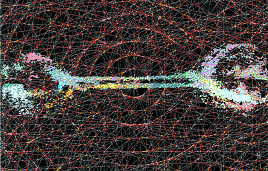
The idea that we have of reality through our brain is at the basic level probably similar to such a picture generated in its spatial network. Landscapes interfere with media, explanatory diagrams, or representations adding some micro/macro perspectives not accessible from a usual human standpoint. Apparently, the smooth perceived reality is processed, filtered, and logically packed before being stored it in the mental circuits of a person that can recreate it freely later as a virtual imitation.
I
This transition from smooth reality to simulated representation may be operated even before the gates of our senses theoretically without a loss in quality. The utility of the representational function of what is usually understood by virtual reality appears. The computer-generated representation follows classical tools as drawings, models, or diagrams. The work they carry is useful to the spectator by reduction of his own imagination effort and by clearing imprecision. But the important new feature is the automatization of repeating logical processes. Sinking to the elementary level and processing an operation very often, the possibility arises of replaying the effects present in nature (As visualizing by computing the trajectory and quality changes of a single ray of light, for example). Mediation to yet unattainable reality follows. It visualizes possible (future), destroyed (past) or remote spaces. The power of the illusion consists in eluding unseen aspects of the physical reality, as the MP3 process cuts redundant or hidden sounds in a tune. Similarly to an intense sensual holiday accepted only after a very long period of sterile concentrated work, VR distills reality to collect its most exorbitant aspects. However, a single algorithm practically became synonymous to the whole domain: rendering. Copying the physics of visible light, the conclusion is inevitable-there is nothing formal behind the limit of sight. Spaces are delimited by razor-thin, texture-mapped surfaces and the construction is a demonstration for a flying-by or flowing-through witness who do not explore some hidden aspects, but comforts himself with the single perfectly orchestrate spectacular path. No issues of scale or real materialization, statics or construction details can be evaluated in this approach. Very abstract presentation follow that is not dissimilar to the early modernist abstraction, a container more and more separated from content. It is interesting to notify that such distinction already appeared in the American skyscraper (as well as in the eclecticism of the 19th century) and is still clearer. The orchestration of interior facilities and programs is becoming completely independent from the facade project. But imagine a critical debate as consequent as if we could see also the X-ray spectrum of light. It would be a reason more to remember the innate beauty and continuity of the buildup of natural structures, as opposed to the use of distinct discovered processes in artificial things. Would it intensify discourse on formal carelessness of things previously hidden behind a sculptural facade, or rather question sculpturality, incoherence in those products?
II
It is evident that this simulation of three dimensions through a one-dimensional logical string is fast, persuading, cheap, practically immaterial (without need of much material support and therefore able to spread virtually pure information in quantities, allowing logical processing and standardization). But such a fake space needs metaphors to be understood easier. With an artificial interface, the organization of complicated data or processes becomes evident, as in the folder system of Macs that won over DOS abstraction. But the goals are off course higher than a 2d desktop-simulation. The immersive illusion started through stories and books attained a temporary technological apex in films, no surprise that some of the most skilled animations are developed for this medium. But at some point, the possible-virtual shifts into reality. The virtual reality becomes stand-alone medium experienced in full 3d quality.
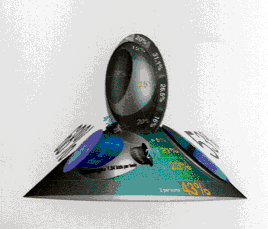
An artificial world as real as our cities, a part of our natural environment, emerges from this logical, ephemeral and ungraspable space and renders once more, in the best tradition of press, complicated materiality and full personal experience obsolete. A comparison with a later medium, TV, is interesting. Although the American suburbs appeared following reasons as mass culture, middle-class wealth or prefabrication, the television reality that grafted itself onto a boring monotony of a periphery refocused the interest of people toward such a cheaper plug-in and maybe sustained the status-quo. The high average of hours spent before the receiver is influencing us through star destinies with unseen consequences. Violence is tolerated for freedom of speech reasons. But psychologists warn that with the virtual reality, there is a pressure on personal behavior (to act violently in order to be successful in a computer game, for example). The involvement is much higher than through a passive consummation of some TV program. A negative aspect if we have in mind the abuse of electronic spaces, but an important insight to appreciate the new intimacy of the medium. Being able to interact, a personal emotional pattern directs own reactions. Creating virtual reality will require giving different personalized options, which at its end will provide more diversity. In ancient Rome, thinkers used to visualize discourses as buildings that they walked through, attributing a space to each argument. This internal tool was a necessity in a time when parchment was expensive, but its utility for organizing information seems to be more and more appreciated today. For the ancient thinkers, these mental representations probably likened classical buildings of that time and had a function similar to that of icons on a computer screen now. All connections were based on easy-to-remember metaphors. The association process is a very common and powerful instrument for logic or memory, understandable and in extensible use today. A slowing down in the creation process may be caused by associations that are sometimes very personal, irrational and not describable through algorithms. But for organizing quantities of information today, new spaces are needed that are interconnected as hypertext and constructed to visualize changing data flows. The fluid medium not restricted to react following to statics or gravity can freely fluctuate and animate changes that it is responding to. Beautiful ephemeral constellations of illusion become one's personal reality and a base for decision making. Such an electronic reality clearly demarcates two domains and transcends the second place usually attributed to imitators: not virtual, not even possible in comparison to physical reality, it goes beyond simulation to unprecedented reality. It has the ability to create new spaces and original aesthetics, as people already did in typography, etc. In addition, if form follows data, it will be more difficult to catch it into some aesthetic point of view, having an intellectual resistance maybe stronger than the one provided by a very fluctuent function or even more through unstable associations.
III
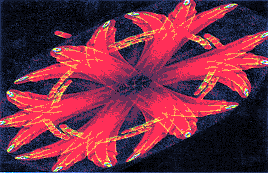
So the changes in the process of creation are evident. The non-striated, not restricted, not even oriented nature of the information instrument changed rather planar outputs to really spatial products. Whereas in the first stage, high computing power is applied to get a realistic idea of an object as a building, an environment, a dinosaur, or other thing conceptualized without much IT tools, there is more to be done. For example, in the automobile industry from the seventies onward, consequent use of computer modeling allowed the use of high-degree curves and surface continuities, mathematical instruments much more evolved than some beveling function in a Cartesian frame. The subsequent incorporation of data as the Cx quotient furnished strong rational base to a form that seemingly drifts away from rationalist's formal prejudices. The shoe industry followed the development, and, recently, architecture seems to take the challenge up. In all products, the disappearing of frame or visible module, but also a higher fluidity can be observed. Even more in small-scale goods, where the technology and the materials (as plastic molds) follow the conceptual evolution. So whereas in some buildings (as Gehry's Guggenheim Bilbao), the computer only made possible a realization of a very complex, but still sculptural approach, in some new creations the electronic treatment of information becomes inherent to the design. The highest challenge using the new instruments is in evaluating the information affecting decisions and choosing the best strategy. Several tasks are already real. The most effective paths for different groups of people or facilities and their crossings may be resolved algorithmically. The intersections or continuity of surfaces are studied by the advancing topology. In architecture, all this interdisciplinary favored by people connected at distance on the net leads to results less influenced by one guild's formal or cultural preferences, and is therefore excellently adapted to a new global situation. The movement patterns token up in the recent realizations of NOX or the attraction of blobs by Greg Lynn proves that the approach, although only at the beginning, is promising. Further possibilities of spatially treating data have to be explored. The above simulation of people leaving the Wembley stadium allows a glimpse into interesting future of correct structures with innate beauty.
This intrusion of engineering into conceptualizing inhabited space of course does not mean that artistic sensibility should be abolished. As Frank Lloyd Wright used concrete with intuition and as an excellent engineer to build correct, clean, and emotionally very attractive spaces, so the new information technologies challenge the fantasy of creators nowadays.
IIII
The information technologies explode reality into infinitesimal meanings to recompose it more intelligible to our consumption. Gathering, interconnecting and processing raw data extracts for us a sense from this amorphous dust. Virtual reality will distribute it most effectively to our senses. Not a mere imitation or simulation anymore, but a fully immersive data driven world that is a new kind of prosthesis - enhancing mental processes. As in the industrial age, describable repetitions are isolated and effected by machines, only with a logical rather than material emphasis. The importance of creativity rises and redundant logical tasks are devaluated. Abandoning the last to the machines, how will we develop the first? The application of new tools changed the output noticeably. The chaotic influences that feed back the creation process are still growing, due to a higher number of sources. The complex connection of know-how seems to allow a boundary-free buildup of the creation process, overdriving lacunary technical knowledge issuing from a hierarchical organization of the team or procedure. But what would be our task if instruments would be able to fantasize better than we do?